Tuning the degree of gloss on a matte glaze: It's about more than just surface character
Monday 21st July 2014
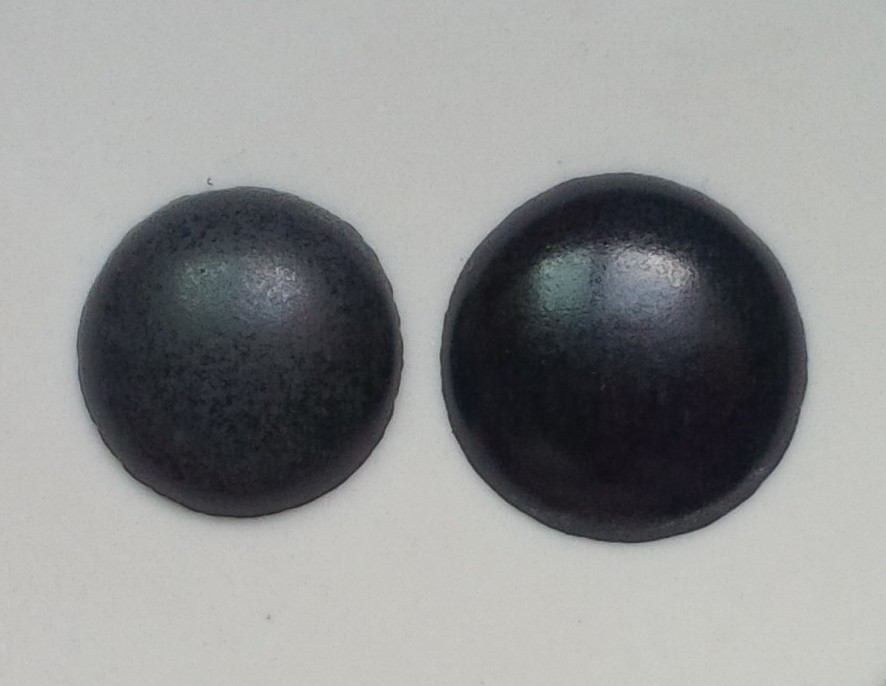
These 10-gram balls were fired and melted down onto a tile. The one on the left is the original G2934 Plainsman Cone 6 insight-live.com/glossary/146">magnesia matte with 6% Mason 6600 black stain. It has been a little too matte (and thus cutlery marking). On the right, the adjustment has a 20% glossy G2926B glaze addition to make it less matte. Notice the increased flow (the ball has flattened more). In addition, while the percentage of stain in the one on the right is actually less, the color appears darker because the more homogeneous glass allows more light penetration and less scattering.
My goal in making it glossier was to make it less prone to cutlery marking. The marking does not happen because the glaze is soft, but because the metal is abraded by microscopic surface roughness. Interestingly, I recovered the degree of matteness by slowing the cooling cycle, letting the kiln create a truer surface texture instead of forcing it through chemistry alone.
Pages that reference this post in the Digitalfire Reference Library:
Mason 6600 Black Stain, Tuning the degree of gloss in a colored matte glaze, Tune your glaze to the degree of matteness you want, The matteness of this glaze depends on the cooling rate, Two cone 6 black glaze recipes I control and adjust A gloss and a matte based on two reliable base recipes, What if G2934 fires too glossy, how can you increase matteness?, From Scribbles to Success: Fixing This Glaze Recipe, Triaxial Glaze Blending, Matte Glaze

This post is one of thousands found in the Digitalfire Reference Database. Most are part of a timeline maintained by Tony Hansen. You can search that timeline on the home page of digitalfire.com.