Five frits. One kiln at 1850F. Big chemistry drama.
Thursday 16th October 2014
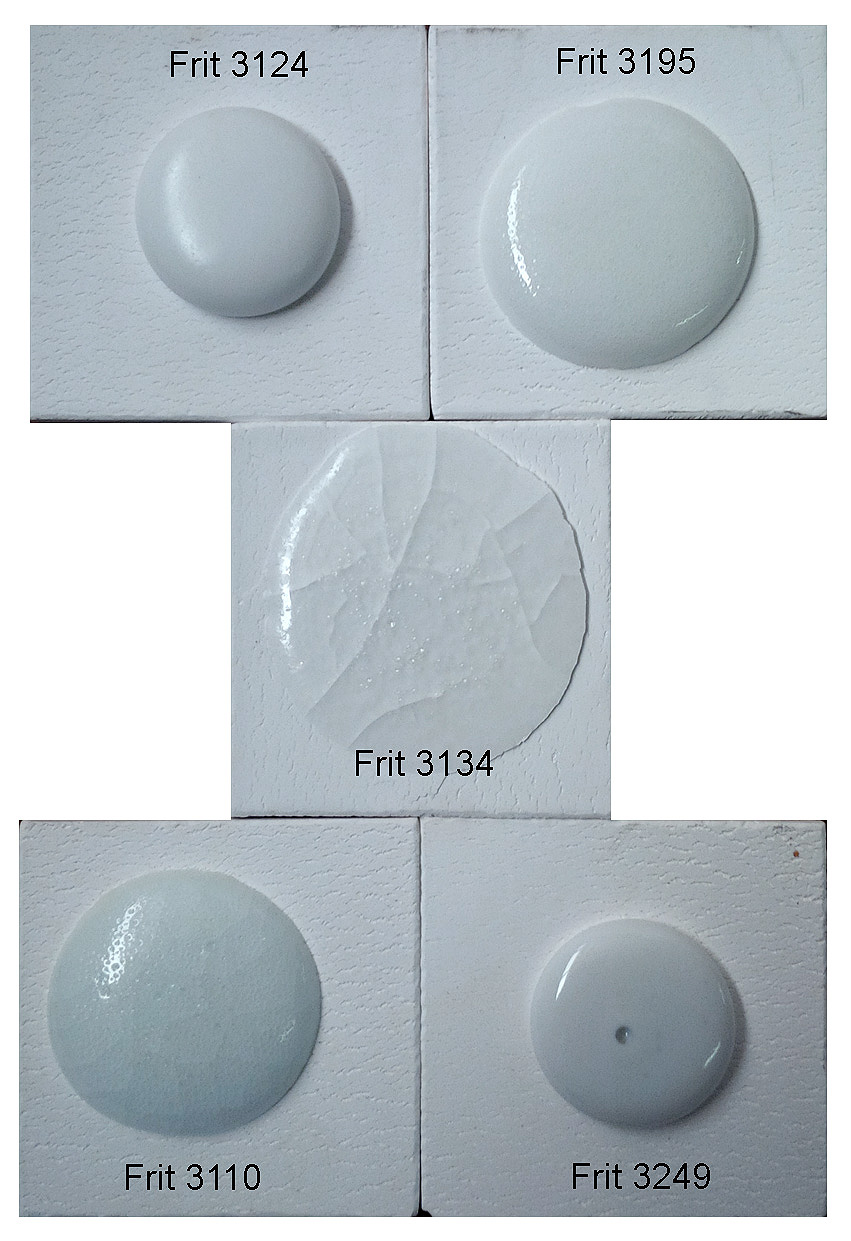
Five common North American Ferro insight-live.com/glossary/43">Frits fired at 1850F on alumina tiles (each started as a 10-gram GBMF test ball and flattened during the firing). At this temperature, the differences are more evident than at 1950F. The degree of melting corresponds mainly, but not only, to the percentage of B2O3 present. Frit 3134 is the runaway leader because it couples that with almost no Al2O3 to stabilize the melt. Notice also the crack pattern, it is also very high in Na2O and thus has a high COE. However, why does Frit 3110 melt so well even though it contains almost no B2O3? Even higher Na2O, it is a powerful flux. Its COE is even higher than Frit 3134, but it is thick enough to have resisted cracking far (but it will in time).
Pages that reference this post in the Digitalfire Reference Library:
Ferro Frit 3124, Ferro Frit 3134, Ferro Frit 3195, Ferro Frit 3110, Ferro Frit 3249, These common Ferro frits used in traditional ceramics

This post is one of thousands found in the Digitalfire Reference Database. Most are part of a timeline maintained by Tony Hansen. You can search that timeline on the home page of digitalfire.com.