Project Name
Slipware using L215
Project Codenumber
UnAssigned
Notes
Can we develop a slipware process here in North America?
Slips are very high in ball clay, no additive is necessary to make them thixotropic. The gelled state persists even with double or more the amount of water that would be in a glaze slurry. The rheology of the slurries is the entire secret of how this is possible.
At this time our main clear glaze is G1916Q and its variants. However, we are investigating the plausibility of using lead bisilicate, as is done in the UK.
Pictures
A freshly slipped earthenware pitcher
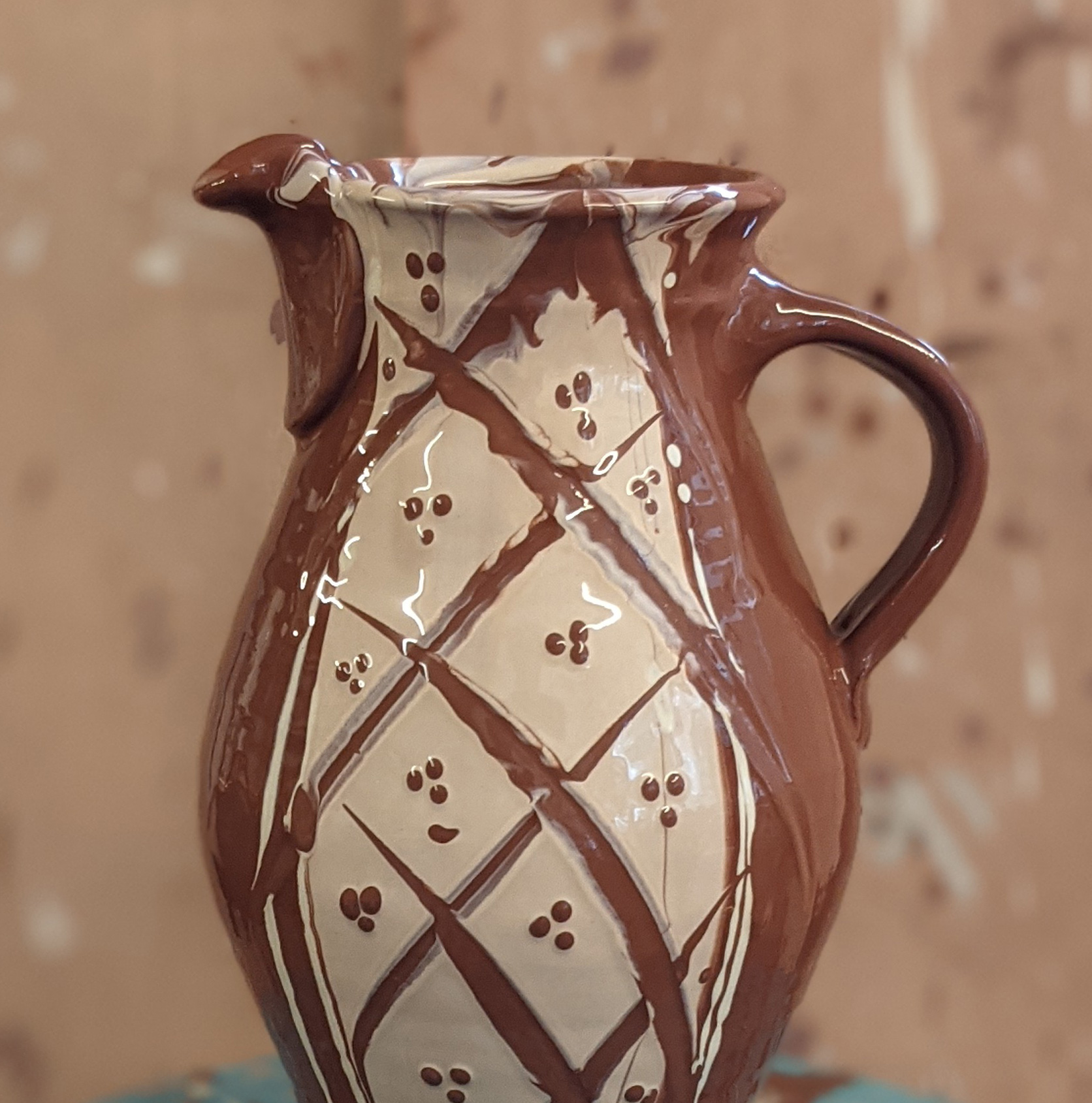
These thickly applied clay slips are defying gravity! This piece has just been engobed using a thixotropic brown slip. The white was applied over that by pouring and the decoration done by scoring and dripping.
Photo courtesy of Russell Kingston, Lynmouth Slipware Pottery.
Slip for Slipware
|
Code # L4599 |
Batch # -2 |
| Materials | Amt |
|---|---|
| OM#4 Ball Clay | 80.000 |
| Custer Feldspar | 20.000 |
Total:100.00
Notes
This was the initial test to see how it was possible for a slip to be as thixotropic as shown on in-process photos of UK made ware. This was done to determine if slipware would be feasible using L215. The answer appears to be yes.
1000g powder mix took 2000g water to produce the thixotropic consistency necessary to hang on to the clay after a dip.
Pictures
L4599 slip on L215
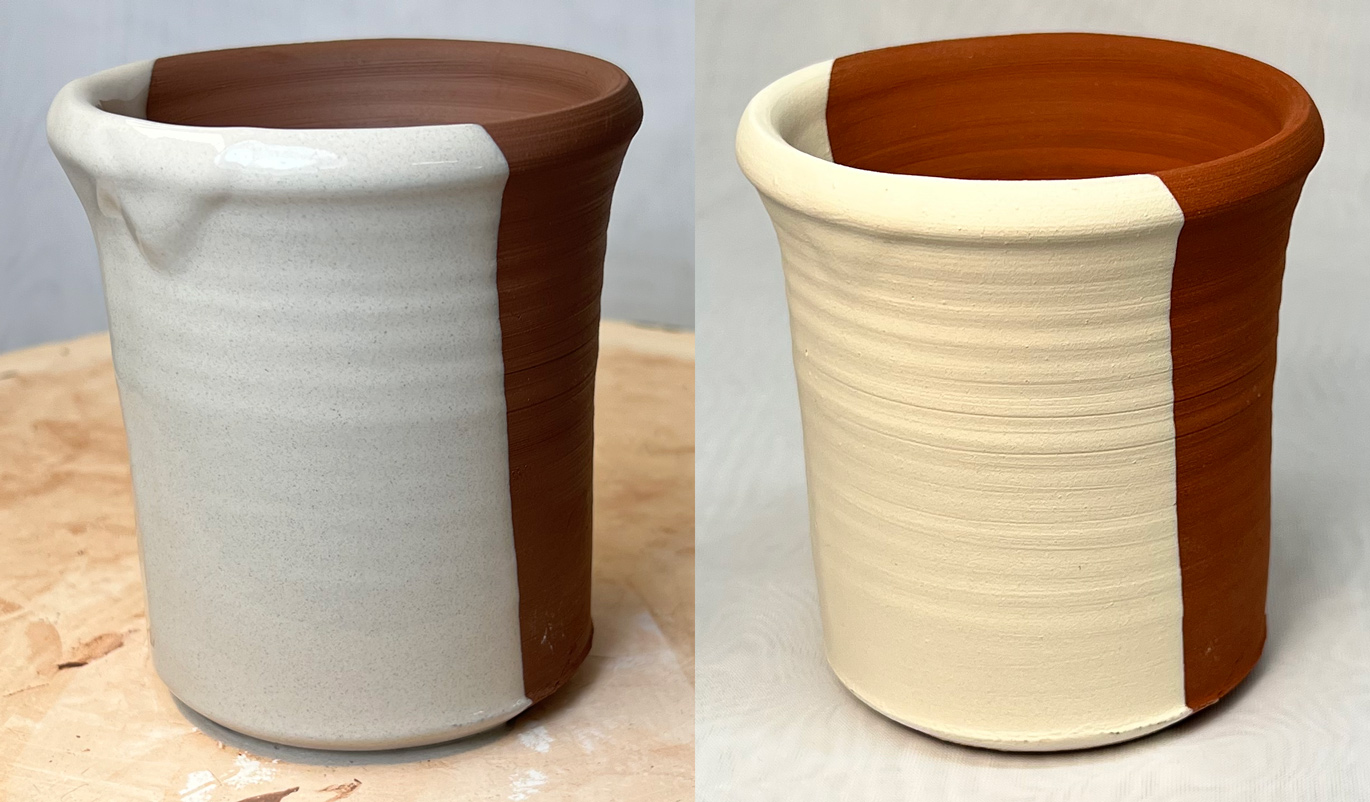
Left: After dip it is hanging on really well. The large drip at the rip was done on purpose. Thousands of tiny black specks are visible, these are the lignite in the OM#4 ball clay.
Right: Fired at cone 04. The slip, although thick when applied, dried down to a thin layer. Because the slip is refractory it is very opaque.
XML (to paste into Insight)
<?xml version="1.0"?> <recipes version="1.0" encoding="UTF-8"> <recipe name="Slip for Slipware" id="230497" key="znaWBaE7" date="2023-03-03" codenum="L4599"> <recipelines> <recipeline material="OM#4 Ball Clay" amount="80.000" tolerance=""/> <recipeline material="Custer Feldspar" amount="20.000" tolerance=""/> </recipelines> </recipe> </recipes>
Born: 2023-01-06, Modified: 2023-03-03 09:20:11
Slip for Slipware - #5 Ball Clay
|
Code # L4599A |
Batch # -2 |
| Materials | Amt |
|---|---|
| Old Hickory #5 Ball Clay | 80.000 |
| Custer Feldspar | 20.000 |
Total:100.00
Notes
The Old Hickory ball clay has no lignite particles and this one is known to be thixotropic (it is used for suspending glazes).
This recipe did not disappoint, it applied beautifully to L215 leather hard and dried without cracks. It also fired to a lighter shade than the OM#4 does.
We range a set of SHAB test bars to assess the firing shrinkage (to make sure it is not under too much tension).
Pictures
Testdata
SHAB - Shrinkage/Absorption
| DLEN | FLEN | FWT | BWT | CONE | DSHR | FSHR | ABS | |
| 5 | 93.58 | 86.86 | 34.22 | 35.3 | 5.0 | 6.4% | 7.2% | 3.2% |
| 4 | 93.14 | 86.45 | 34.96 | 37.17 | 4.0 | 6.9% | 7.2% | 6.3% |
| 3 | 92.87 | 87.78 | 35.41 | 38.57 | 2.0 | 7.1% | 5.5% | 8.9% |
| 2 | 93.39 | 90.42 | 34.97 | 39.74 | -2.0 | 6.6% | 3.2% | 13.6% |
| 1 | 93.4 | 92.47 | 34.58 | 40.88 | -4.0 | 6.6% | 1.0% | 18.2% |
XML (to paste into Insight)
<?xml version="1.0"?> <recipes version="1.0" encoding="UTF-8"> <recipe name="Slip for Slipware - #5 Ball Clay" id="230750" key="9TyZTwRd" date="2023-03-03" codenum="L4599A"> <recipelines> <recipeline material="Old Hickory #5 Ball Clay" amount="80.000" tolerance=""/> <recipeline material="Custer Feldspar" amount="20.000" tolerance=""/> </recipelines> </recipe> </recipes>
Born: 2023-01-06, Modified: 2023-03-03 09:23:31
L215 Production Run - Mar 2020
|
Code # P6821 |
Batch # -2 |
Notes
Produced March 18-19/2020 445 boxes pugged clay.
Drying shrinkage is higher than it used to be.
The red color is supplied by a mix of BGP and M2 (the ratio has be adjusted a little, increasing the BGP).
Tried firing a bar to cone 5 as we know that by cone 6 it bloats for sure, and the cone 5 bar is just beginning to show signs of bloating.
Pictures
P6821 L215 fired bars
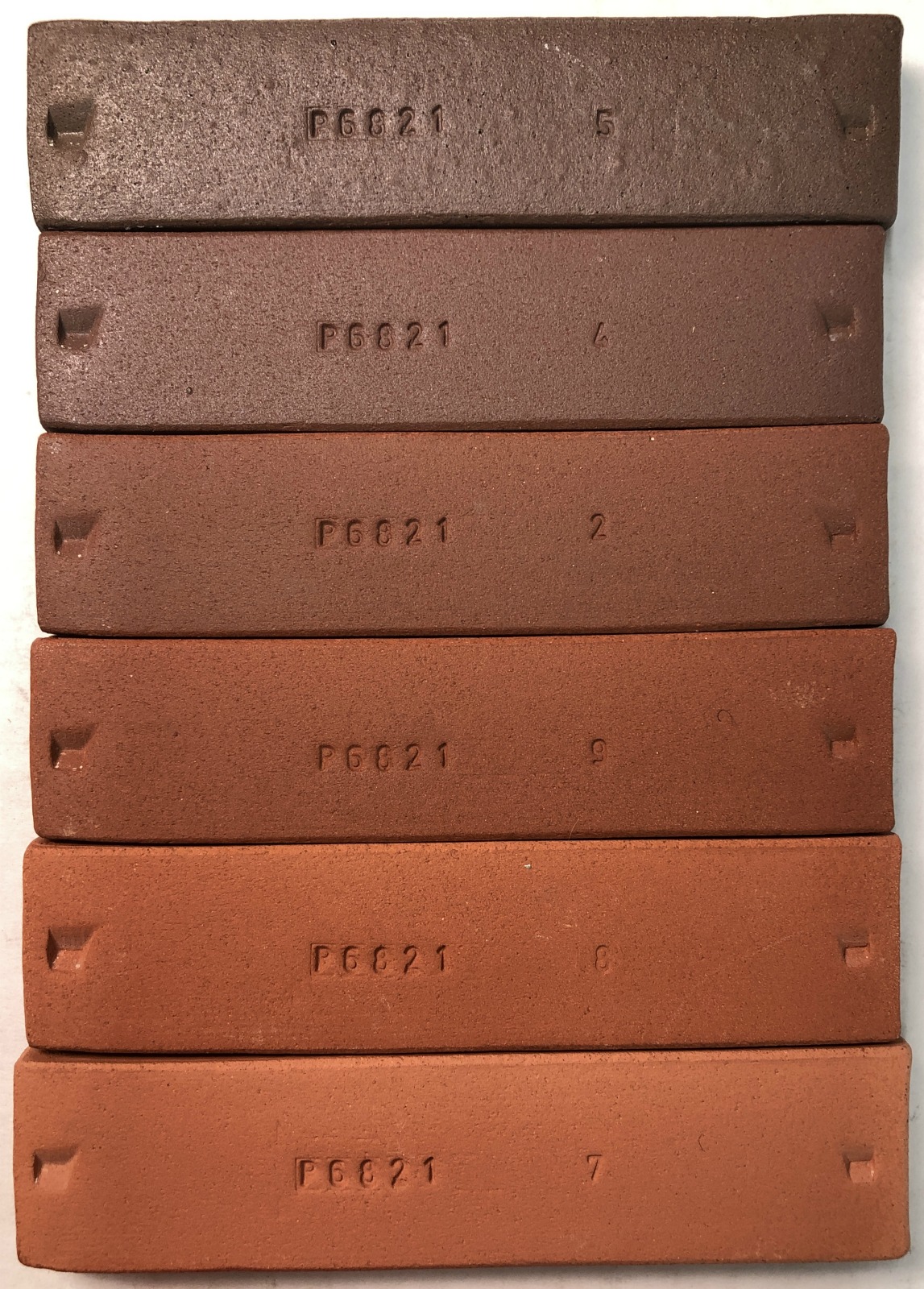
Top to bottom: Cones 5, 4, 2, 02, 04, 06.
Alternate Code Number:5482
Testdata
SHAB - Shrinkage/Absorption
| DLEN | FLEN | FWT | BWT | CONE | TEMP | DSHR | FSHR | ABS | |
| 5 | 92.32 | 89.50 | 38.30 | 41.45 | 5.0 | bloat | 7.7% | 3.1% | 8.2% |
| 4 | 92.34 | 86.81 | 39.14 | 39.46 | 4.0 | 7.7% | 6.0% | 0.8% | |
| 2 | 92.39 | 87.20 | 39.23 | 40.00 | 2.0 | 7.6% | 5.6% | 2.0% | |
| 9 | 92.24 | 87.77 | 39.17 | 40.47 | -2.0 | 7.8% | 4.8% | 3.3% | |
| 8 | 92.20 | 89.37 | 39.21 | 41.81 | -4.2 | 7.8% | 3.1% | 6.6% | |
| 7 | 92.33 | 91.42 | 38.78 | 42.90 | -6.0 | 7.7% | 1.0% | 10.6% |
SOLU - Soluble Salts
| FIRE | |
| 10 | nil |
DFAC - Drying Factor
| DFAC | SOLD | |
| 1 | A000 | NIL |
CLWC - Clay Water Content - Powder, Plastic
| WPOW | WPUG | PUGW | PUGD | POW% | PUG% | |
| 1 | 2.32 | 21.03 | 20.26 | 16.33 | 19.4% |
LDW - LOI/Density/Water Content
| WWGT | DWGT | FWGT | H2O | LOI | DENS | |
| 1 | 16.11 | 13.02 | 12.25 | 19.2% | 5.9% |
XML (to paste into Insight)
Born: 2020-03-20, Modified: 2025-03-27 15:47:28
