Cone 10/10R Transparent Base
|
Code # G1947U |
Batch # -2 |
| Materials | Amt |
|---|---|
| Custer Feldspar | 27.000 |
| EP Kaolin | 20.500 |
| Silica | 26.500 |
| Wollastonite | 23.500 |
| Zinc Oxide | 2.500 |
Total:100.00
Auto Unity Formula
|
Si:Al: 9.2:1 6.5 (Molar:6.3) 3.1 Cost 0.00 per kg |
Notes
This glaze can be used in oxidation or reduction for a crystal clear. It works well in reduction on whiteware bodies like Plainsman P580 and P590 and is also good on all other high temperature stonewares (even iron reduction).
Add Zircopax (up to 15%) for white, and stains for colors as desired. Colors however will be more subdued than at lower temperatures and some, such as chrome-tin pinks, may not work at all.
Add 2-15% iron for a whole range of celadon, brown crystal, tenmoku, kaki, translucent brown and crystaline glazes. About 11% is good for a tenmoku. If the iron fluxes the glaze too much, remove the zinc.
This glaze has been tested in high temperature oxidation and produces the same glossy transparent. However, on stoneware bodies with coarser particle sizes the surface can be slightly dimpled. It does not seem to make a difference whether the zinc is removed or not.
Some stains that work very well at this tempature are mason stains no. 6242,6464,6305,6319,6364,6134, and 14k139. I found it was better to apply the stain over the glaze then under.
Pictures
Ravenscrag GR10 variations outside, G1947U inside

Left mug inside: G1947U clear
Left & right mugs outside: GR10-CW White
Right mug inside: GR10-A transparent (pure Ravenscrag Slip)
Clay body is H550.
H550 with RavenTalc base, G1947U Transparent

The G1947U (right) really enhances the speckle. The GR10-C (left) mutes it much more and adds color.
G1947U, G3910 on H443 at Cone 10R

The fritted version on the right is pickup up the iron color and has less micro-bubbles, thus is more transparent.
G1947U, G3910 on H550 at Cone 10R
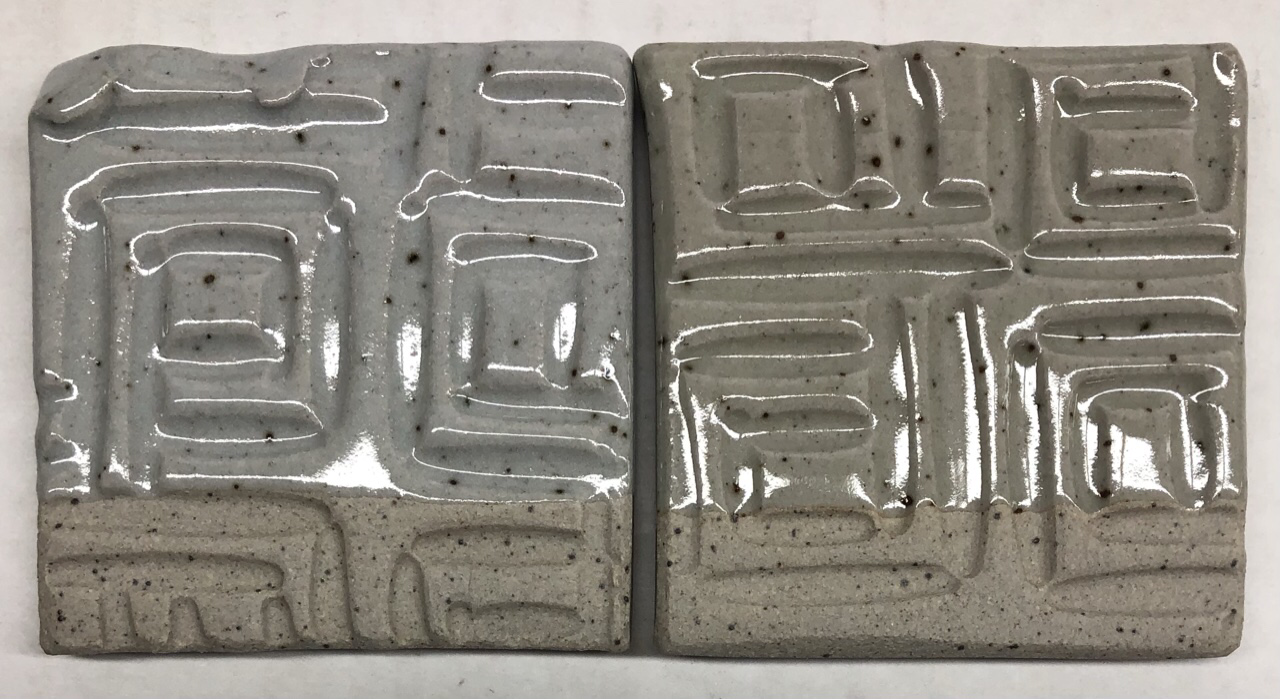
G1947U is more opaque, likely because it is hosting more micro-bubbles.
G1947U on H570 an H550 - Cone 10R

On H450, P600 at cone 10 oxidation

On H450, P600 at cone 10 oxidation
G1947U using Grolleg Kaolin

P700 porcelain P5797. Left: EPK. Right: Grolleg Kaolin (produces bluish color).
Typecodes
ST-Untitled typecode
Alternate Code Number:GS10-C
XML (to paste into Insight)
<?xml version="1.0"?> <recipes version="1.0" encoding="UTF-8"> <recipe name="Cone 10/10R Transparent Base" id="63912" key="xr6i9p4R" date="2025-06-26" typecodes="ST" codenum="G1947U" picturebasename=""> <recipelines> <recipeline material="Custer Feldspar" amount="27.000" tolerance=""/> <recipeline material="EP Kaolin" amount="20.500" tolerance=""/> <recipeline material="Silica" amount="26.500" tolerance=""/> <recipeline material="Wollastonite" amount="23.500" tolerance=""/> <recipeline material="Zinc Oxide" amount="2.500" tolerance=""/> </recipelines> </recipe> </recipes>
Born: 1994-06-30, Modified: 2025-06-26 18:17:23
Grey Cone 10 Porcelain Insulator Glaze
(insufficient melting)
|
Code # G4617 |
| P | Materials | Amt | |
|---|---|---|---|
| Potash Feldspar | 28.000 | 32.18% | |
| Kaolin | 8.000 | 9.20% | |
| Ball Clay | 4.000 | 4.60% | |
| Silica | 30.500 | 35.06% | |
| Wollastonite | 11.500 | 13.22% | |
| Calcium Carbonate | 5.000 | 5.75% |
| P | Additions | ||
|---|---|---|---|
| * | Zircon | 11.500 | 13.22% |
| *Grey Stain | 1.200 | 1.38% |
Total:99.70
Auto Unity Formula
|
Si:Al: 11.0:1 6.7 (Molar:6.2) 4.2 |
Notes
Our G1947U glaze, shown here on the left, also originated in a porcelain insulator plant. It was also the base for thier grey glazed products.
Compare the chemistry instead of the recipes. This has alot more SiO2, which raises the melting temperature. Much of the SiO2 in G1947U comes from wollastonite, which goes into solution in the melt more easily. And it has 2.5 zinc oxide, that gets melting started earlier (although it may volatilize later in firing). This glaze only has 12% clay, so the slurry will not suspend and dry as hard.
Pictures
XML (to paste into Insight)
<?xml version="1.0"?> <recipes version="1.0" encoding="UTF-8"> <recipe name="Grey Cone 10 Porcelain Insulator Glaze" keywords="(insufficient melting)" id="297278" key="G5nBkYS6" date="2026-10-31" codenum="G4617"> <recipelines> <recipeline material="Potash Feldspar" amount="28.000" tolerance=""/> <recipeline material="Kaolin" amount="8.000" tolerance=""/> <recipeline material="Ball Clay" amount="4.000" tolerance=""/> <recipeline material="Silica" amount="30.500" tolerance=""/> <recipeline material="Wollastonite" amount="11.500" tolerance=""/> <recipeline material="Calcium Carbonate" amount="5.000" tolerance=""/> <recipeline material="Zircon" amount="11.500" added="true"/> <recipeline material="Grey Stain" amount="1.200" added="true"/> </recipelines> </recipe> </recipes>
Born: 2026-10-29, Modified: 2026-10-31 01:31:58
