Cone 6 Dolomite Testing Glaze
|
Code # L3728 |
Batch # -2 |
| Materials | Amt |
|---|---|
| Ferro Frit 3124 | 20.000 |
| EP Kaolin | 21.000 |
| Dolomite | 27.000 |
| Silica | 32.000 |
Total:100.00
Auto Unity Formula
|
Si:Al: 9.1:1 5.9 (Molar:5.8) 16.0 |
Notes
This was the parent of our G2934 cone 6 matte glaze recipe. It was done as a formula-to-batch calculation to derive a recipe having as much MgO as possible (past the upper normal limit of 0.35) and near a tipping point between matteness and gloss, opacify and transparency. This makes it sensitive to changes in dolomite chemistry (dolomite being the source of the MgO). The glaze melts well due to a combination of the 20% frit and low Al2O3 and SiO2.
This recipe demonstrates that high MgO can be tolerated in a well-melted glaze and that its presence alone is not enough to ensure a matte surface, plenty of Al2O3 is also needed.
Pictures
L3728 Dolomite Comparison Glaze

Two brands of dolomite are being compared, demonstrating how sensitive this recipe is for this purpose.
G1214Z CaO matte vs 2928C MgO matte

Despite being a matte G1214Z is well melted, more than a glossy transparent would be. The development of calcium silicate crystals depends on this high melt fluidity.
The MgO matte on the right (the G2934 recipe made using Ravenscrag Slip) is much less fluid. This also is needed, the viscous melt prevents the surface from flattening during cooling.
This test was not slow cooled.
G2934 vs G2934A at cone 6
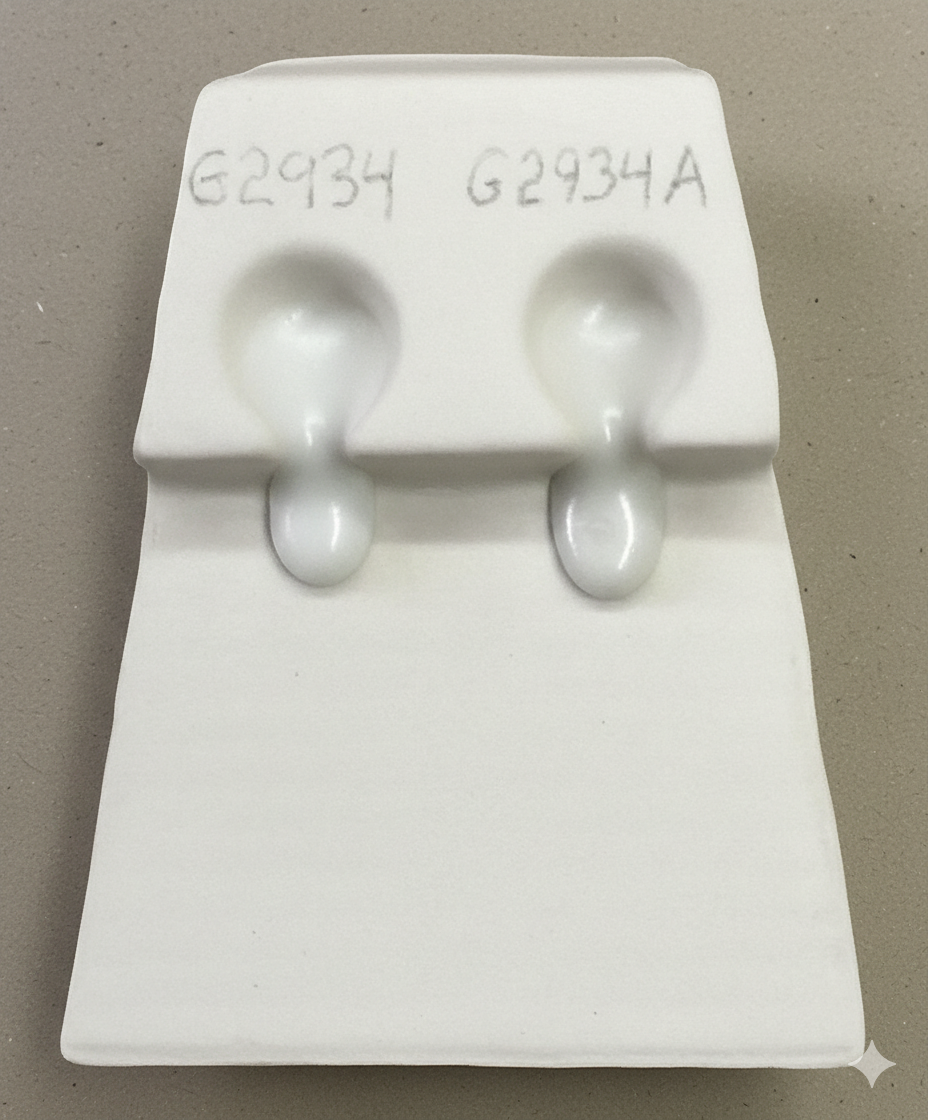
G2934A is the dolomite testing recipe with added SiO2 (from 2.37 to 3.13) and slightly lower Al2O3.
This has not glossed as expected, the MgO is still working. And it is melting better, unexpected since SiO2 is a refractory oxide. But it appears the reduction in Al2O3 more than made up for the increase in SiO2.
Typecodes
MAT-Matte Glaze
XML (to paste into Insight)
<?xml version="1.0"?> <recipes version="1.0" encoding="UTF-8"> <recipe name="Cone 6 Dolomite Testing Glaze" id="56793" key="ErykWz1Z" date="2026-01-15" typecodes="MAT" codenum="L3728" picturebasename=""> <recipelines> <recipeline material="Ferro Frit 3124" amount="20.000" tolerance=""/> <recipeline material="EP Kaolin" amount="21.000" tolerance=""/> <recipeline material="Dolomite" amount="27.000" tolerance=""/> <recipeline material="Silica" amount="32.000" tolerance=""/> </recipelines> </recipe> </recipes>
Born: 2014-03-04, Modified: 2026-01-15 19:54:16
High Dolomite-Testing glaze
|
Code # G2934A |
Batch # -2 |
| Materials | Amt | |
|---|---|---|
| Ferro Frit 3124 | 17.540 | 17.56% |
| EPK | 14.400 | 14.42% |
| Dolomite | 23.600 | 23.63% |
| Silica | 44.350 | 44.40% |
Total:99.89
Auto Unity Formula
|
Si:Al: 14.4:1 5.5 (Molar:5.4) 13.4 Cost 0.00 per kg |
Notes
This is an adjustment to L3728 dolomite testing glaze to get an Si:Al ratio of 14:1 for high gloss. This employs the regular stock dolomite (used here for 35 years).
Did not fire gloss, still matte!
The proposed new dolomite is from the IMASCO plant in Sirdar, B.C.
Pictures
G2934 vs G2934A at cone 6
G2934A is the dolomite testing recipe with added SiO2 (from 2.37 to 3.13) and slightly lower Al2O3.
This has not glossed as expected, the MgO is still working. And it is melting better, unexpected since SiO2 is a refractory oxide. But it appears the reduction in Al2O3 more than made up for the increase in SiO2.
Typecodes
MAT-Matte Glaze
XML (to paste into Insight)
<?xml version="1.0"?> <recipes version="1.0" encoding="UTF-8"> <recipe name="High Dolomite-Testing glaze" id="56794" key="9YSNQYza" date="2026-01-27" typecodes="MAT" codenum="G2934A" picturebasename=""> <recipelines> <recipeline material="Ferro Frit 3124" amount="17.540" tolerance=""/> <recipeline material="EPK" amount="14.400" tolerance=""/> <recipeline material="Dolomite" amount="23.600" tolerance=""/> <recipeline material="Silica" amount="44.350" tolerance=""/> </recipelines> </recipe> </recipes>
Born: 2014-03-24, Modified: 2026-01-27 15:02:30
Cone 6 Magnesia Matte Base
|
Code # G2934 |
Batch # -2 |
| Materials | Amt | |
|---|---|---|
| Ferro Frit 3124 | 19.400 | 19.01% |
| EP Kaolin | 18.300 | 17.93% |
| Dolomite | 23.500 | 23.03% |
| Silica | 26.960 | 26.42% |
| Calcined Kaolin | 13.900 | 13.62% |
Total:102.06
|
Si:Al: 6.0:1 5.8 (Molar:5.7) 13.6 |
Notes
This is a magnesia matte, akin to that used in the floor tile industry to non-slip surfaces. In our standard firings, this recipe produces both good mattenss and a durable surface coupled with a low chance of crazing on almost any body. This is not a reactive matte, it is intended for functional and durable surfaces. The degree of matteness is adjustable by changing the Si:Al ratio.
WARNING: The degree-of-matteness is very dependent on the cooling rate in the kiln. Fast cooling (e.g. our PLC6DS firing schedule in a lightly-loaded or smaller kiln) produces a silky matte or even glossy surface that is more functional. Slower cooling (e.g. a heavily loaded kiln or the C6DHSC schedule) may produce a matter surface than you need (more subject to cutlery marking). Control the degree of mattness in three ways:
-Changing the firing curve
-Blending in some glossy G2926B
-Adjusting the recipe to source more SiO2.
This has a very low thermal expansion, meaning it will not craze on just about any clay body. However, on some, it could shiver or lead to glaze compression issues. Use G2934Y2 if this is a problem for you. Or, experiment with adding silica and slow cooling to achieve a balance that contains the most silica possible but is still matte enough. The more silica it will take, the more durable it will fire.
https://plainsmanclays.com/g2934 documents this recipe using a variety of stains.
Pictures
Incredible cone 6 speckle body with G2934 matte glazes

This clay, L4115J3S, a Plainsman 3D-based body, fires vitreous and dense, yet there is no hint of bloating. With these matte glazes very durable and functional pieces are produced.
Outside glaze on both is G2934W (adds 10% zircopax). In our C6DHSC firings this produces as matte a surface as is possible without having excessive staining problems. To add a little gloss we blend in 15% of the G2926B Glossy clear.
Inside glazes:
Left mug: L4423A (85:15 mix of G2934 matte/G2926B clear glossy). It does not contain any zircopax.
Right mug: G2926B ball milled glossy, producing a striking visual yet highly functional surface.
These mugs look as close to cone 10R dolomite-glazed ware as we have ever seen! Especially the L4423A recipe
The difference cooling-rate makes

These are the G2934 black glaze at cone 6. The piece on the left was fired using the C6DHSC firing schedule (drop-and-hold at 2100F then 150F/hr to 1400F). The one on the right was fired using the PLC6DS schedule (drop-and-hold at 2100F then free-fall from there). The slow cool gives the glaze on the left time to crystallize, creating a stony matte.
G2934 + 5% Titanium thinner/thicker on M390

G2934 Cone 6 Matte + 4% iron oxide

Left: PLC6DS firing
Right: C6DHSC firing
G1214Z CaO matte vs 2928C MgO matte
Despite being a matte G1214Z is well melted, more than a glossy transparent would be. The development of calcium silicate crystals depends on this high melt fluidity.
The MgO matte on the right (the G2934 recipe made using Ravenscrag Slip) is much less fluid. This also is needed, the viscous melt prevents the surface from flattening during cooling.
This test was not slow cooled.
G2934 vs G2934A at cone 6
G2934A is the dolomite testing recipe with added SiO2 (from 2.37 to 3.13) and slightly lower Al2O3.
This has not glossed as expected, the MgO is still working. And it is melting better, unexpected since SiO2 is a refractory oxide. But it appears the reduction in Al2O3 more than made up for the increase in SiO2.
True mattes should still be matte if overfired

GBMF test to compare.
The G2934 is a high-MgO matte, it melts well and does not cutlery mark or stain easily. As evidence that it is a true matte, notice that it is still matte when fired to cone 7 or 8. VC71, while having a similar pleasant silky matte surface at cone 6, converts to a glossy if fired higher (suggesting that its cone 6 matteness is due to incomplete melting). For the same reason the VC71, it is whiter in color (but as soon as it begins to melt and have depth the color darkens).
G2934 with Hemlock Green, Pansy Purle Stains
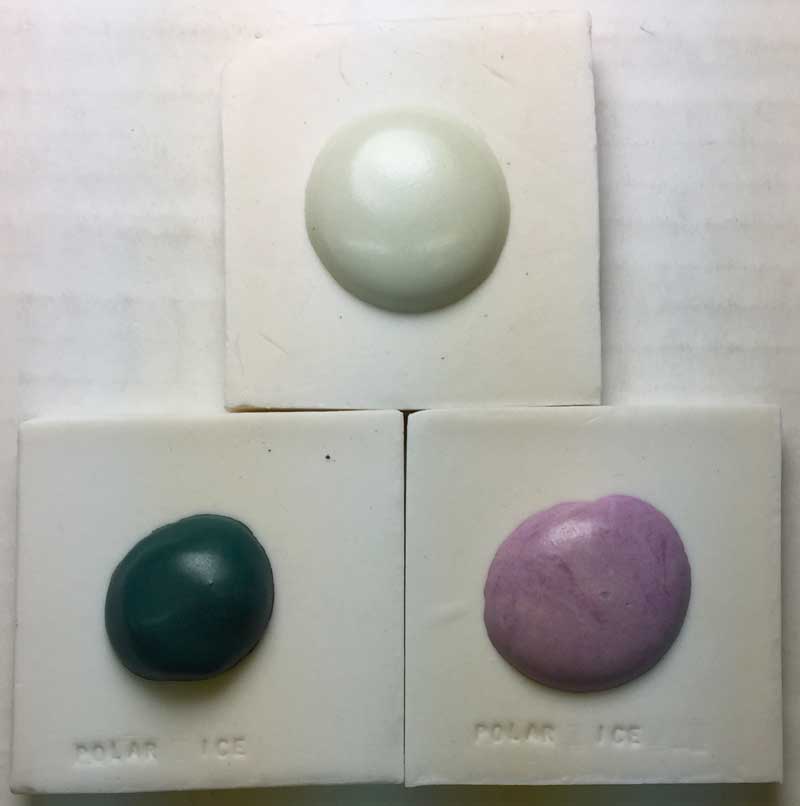
Cone 6 GBMF tests: 10 gram balls have been melted down onto a tile at cone 6.
Top: G2934 with normal flow.
Left: 8% 6213 Hemlock Green. Needs significant flux.
Right: 8% 6305 Violet stain. Flowing a little less, needs a little flux.
Melt flow comparison: G2934 with Frit 3124, Frit F-19

Fusion Frit F-19 is giving a more fluid melt.
URLs
Prepared public do..om Plainsman Clays
Typecodes
C6-Crawl Cone 6
Alternate Code Number:MG6CDM
XML (to paste into Insight)
<?xml version="1.0"?> <recipes version="1.0" encoding="UTF-8"> <recipe name="Cone 6 Magnesia Matte Base" id="56852" key="RD1z7e7o" date="2026-10-01" typecodes="C6" codenum="G2934" picturebasename=""> <recipelines> <recipeline material="Ferro Frit 3124" amount="19.400" tolerance=""/> <recipeline material="EP Kaolin" amount="18.300" tolerance=""/> <recipeline material="Dolomite" amount="23.500" tolerance=""/> <recipeline material="Silica" amount="26.960" tolerance=""/> <recipeline material="Calcined Kaolin" amount="13.900" tolerance=""/> </recipelines> </recipe> </recipes>
Born: 2014-03-21, Modified: 2026-10-01 17:04:09
